Search
Featured Programs


 News


 20/08/2026 16:03
 Editor:
Tomasz Koper


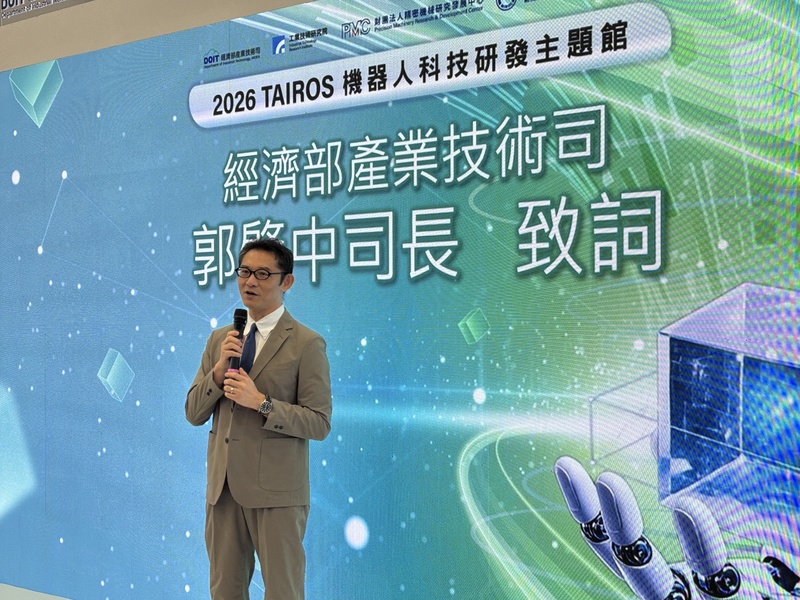
The Economic Ministry unveiled its Innovation Tech Hub themed pavilion at the 2026 Taiwan Automation Intelligence and Robot Show on Wednesday, August 19. The space brings together R&D achievements of various research institutes and showcases 16 innovative smart robotics technologies.
Among the highlights were six projects from the Industrial Technology Research Institute (ITRI), a dual-arm transport robot from the Precision Machinery Research and Development Center, and a medical-care robot developed by the Metal Industries Research and Development Centre.
ITRI presented its quadruped robot, which integrates sensing, autonomous balance, navigation, and intelligent decision-making. It has been developed as a domestic R&D platform in collaboration with private companies including Compal, Inventec, and Solomon Technology. The robot may be used in firefighting, disaster response, and public safety inspections.
Economic Ministry’s Department of Industrial Technology Director-General Kuo Chao-chung (郭肇中) said in an interview that the global robotics market was worth approximately US$90 billion last year and is projected to grow to US$200 billion in 2030.
Kuo said that while Taiwan may not directly compete with companies like Meta and Google in the AI software space, it possesses strong hardware manufacturing capabilities. He said that hardware could be upgraded with AI into smart equipment applicable across different fields.
Kuo explained that the Department of Industrial Technology’s role is to go “from 0 to 1,” establishing key technologies and systems, which are then further scaled with the help of agencies such as the Economic Ministry’s Industrial Development Administration. Kuo offered the example of ITRI’s quadruped robot, saying that his department supported ITRI in systems integration, building an open platform using plug-and-play framework, which allows domestic companies to swap out components such as motors, sensors, and joints depending on scenario. This kind of open platform allows companies to participate in robotics R&D, lowers entry barriers, and helps build up domestic supply chains and systems integration capabilities.






 /
 Experts say China spying case ‘tip of iceberg’ of Beijing’s transnational repression