Search
Featured Programs


 News


 08/09/2026 15:16
 Editor:
Hanna Bilinski


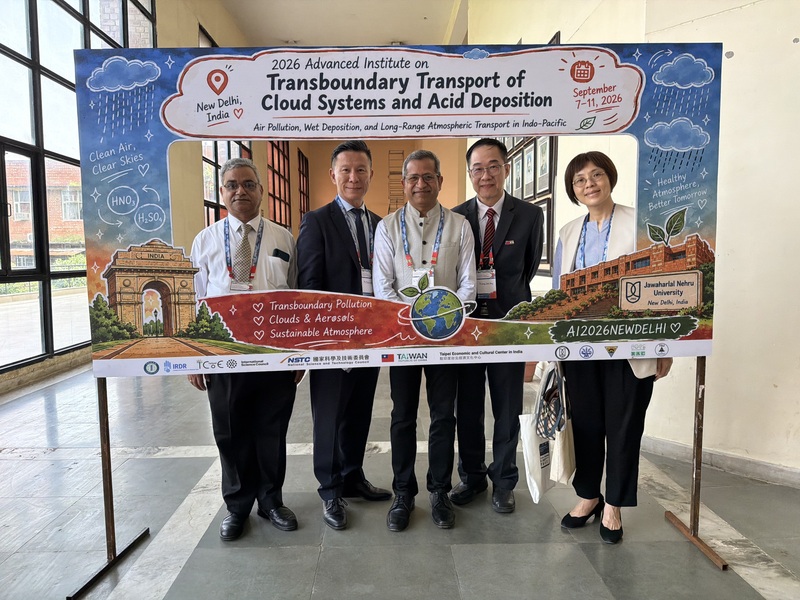
A group of Taiwanese researchers studying methods of mitigating the cross-border spread of air pollution traveled to New Delhi this week to share their experience in the field. The team arrived Monday and will spend five days at Jawaharlal Nehru University speaking with academics and experts from multiple countries with the hope of contributing to efforts to tackle air pollution.
Deputy Representative to India Wang Wei-lung (王韋龍) stated in an interview that Taiwan began studying transboundary pollution relatively early, with the government and scientists placing significant emphasis on the issue about 30 years ago. This led to a substantial research foundation covering areas such as monitoring technologies and government strategies.
Wang said that India and several South and Southeast Asian countries are severely affected by air pollution, which is closely linked to public health. The seminar focuses on linking air pollution to health in order to draw greater attention to the issue. Governments in South and Southeast Asian countries, he noted, often struggle to keep up with public expectations when implementing relevant policies. Scientists can provide monitoring results and use scientific data to give the public a voice while offering governments evidence to inform policymaking.
Nina Yunung Lin (林玉儂), an associate research fellow at Academia Sinica’s Institute of Earth Sciences, told reporters that Academia Sinica holds workshops overseas every year to share Taiwan’s extensive experience in disaster response and advanced technologies. Through such “soft power,” she said, Taiwan hopes to make an impact and contribution to neighboring countries.






 /
 Retired US Navy admiral says China's gray-zone strategy against Taiwan is 'hollow'