Search
Featured Programs


 News


 08/09/2026 15:18
 Editor:
Hanna Bilinski


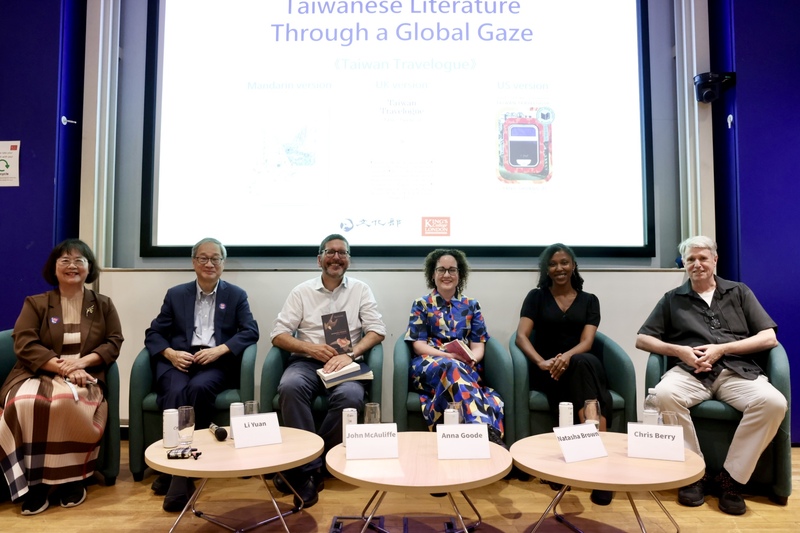
The UK Taipei Representative Office’s Cultural Division and King’s College London on Monday held a panel discussion on making Taiwan more visible through its literature featuring Culture Minister Li Yuan (李遠).
The session, titled “Taiwanese Literature Through a Global Gaze,” was moderated by King’s College London professor Chris Berry and covered how Taiwanese literature emerged from the period of martial law and developed its own sense of identity, as well as translation, publishing, and international strategies. Li was joined by chair of the 2026 International Booker Prize judging panel Natasha Brown, British Centre for Literary Translation (BCLT) Executive Director Anna Goode, and Irish poet and scholar John McAuliffe.
Reflecting on his generation of writers, Li pointed out that as information was tightly restricted during the martial-law era, Taiwanese literature primarily sought its identity between two movements: Taiwan nativist literature and modernism. Following democratization, a new generation began looking back at history in more diverse ways, giving rise to forms of writing encompassing ecology, magical realism, LGBTQ literature, the White Terror, Indigenous literature, and local and regional narratives.
“I think all cultures are rooted in their native soil, and as history unfolds, it continuously takes on new forms. We have finally in some sense come to ‘see’ our own country. Now we can show it to the rest of the world,” Li said.
Natasha Brown revealed that the judges read approximately 130 works, and that Yang Shuang-zi's (楊双子) novel “Taiwan Travelogue” stood out because of its nuanced treatment of colonial history, linguistic differences, and relationships between its characters. The novel also resonated with readers from diverse cultural backgrounds.
Brown also emphasized that although the work deals with a complex colonial history, it brings the sweeping forces of history back down to the personal level. It was, she said, a book that the judges continued to love even after reading it repeatedly.
In his closing remarks, Li said that the government has for the past few years been investing in areas ranging from creative-writing grants and translator training to the setup of Taiwan Pavilions at international book fairs. Taiwanese literature has now been translated into 36 languages. He stressed that Taiwan and the UK already have extensive cooperation in economics and technology and expressed hope that cultural exchanges between the two sides would become even closer in the future.





 /
 Experts say China spying case ‘tip of iceberg’ of Beijing’s transnational repression