Search
Featured Programs


 News


 08/10/2026 14:12
 Editor:
Tomasz Koper


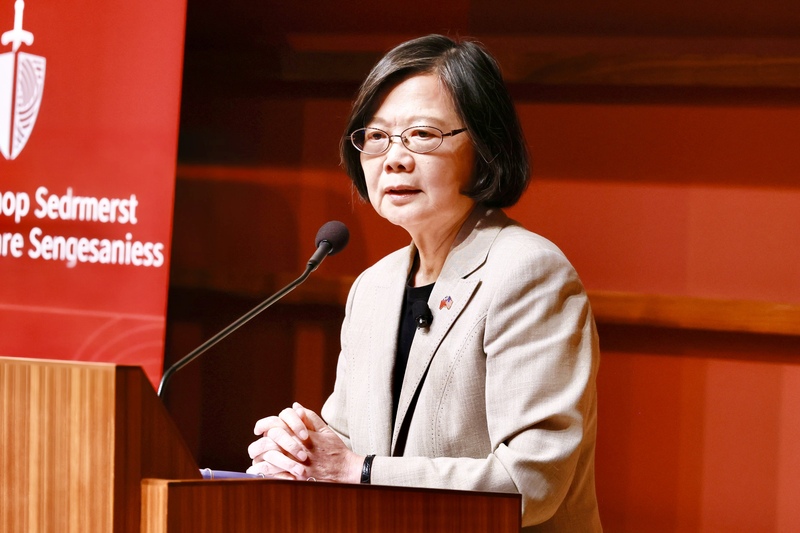
International news coverage shows Taiwan as a place with security risks that needs help from other countries, but this is only part of the picture. The country is one of few democracies with the ability to add manufacturing capacity and help solve supply problems, rather than merely a recipient of security support. Those statements came from former President Tsai Ing-wen (蔡英文) during her speech at the Stanford DEFCON 2026 Technology and National Security Conference on Wednesday, October 7.
Tsai said Taiwan faces cyberattacks, cognitive warfare, information manipulation, economic coercion, and attempts to damage critical infrastructure every day. At the same time, Chinese military aircraft, warships, and coast guard vessels operate around Taiwan with increasing frequency. Taiwan cannot prepare only for large-scale military conflict, but must also keep responding to gray zone pressure, maintain confidence and freedom of action, and strengthen its self-defense capabilities.
Tsai noted the Taiwan Strait is a vital shipping route for goods and energy, while the country is deeply integrated into global technology and manufacturing networks. A serious disruption would have effects across the Indo-Pacific and beyond. She gave the example of artificial intelligence, in which the United States currently holds roughly three-quarters of the world’s computing capacity. Almost all advanced chips used in AI systems, however, as well as about 90 percent of AI servers are made by Taiwanese companies.
Tsai said advanced defense technology must be fit for mass production, rapid iteration, and timely delivery, which are exactly the capabilities Taiwan’s industry has built up over the decades.
The former president noted that Taiwan sits at the center of the first island chain and is an important member of the global technology industry. Its geographic location, democratic system, technological capability, and industrial strength give Taiwan a role that is hard to replace.
Tsai stressed that democratic partners should combine their respective advantages to jointly build the industrial and technological capacity that security requires. She added that if technology, industry, and security are to be made resilient, Taiwan is not just an important partner, but an indispensable one.


 /
 Taiwan says communication with US remains open ahead of Trump-Xi talks